



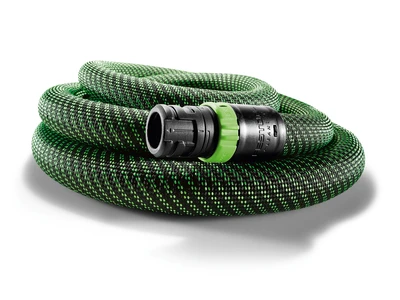
The Dust Extraction Column is placed on the back of the OF 2200 and extends to the top of the router and includes a swivel nozzle. A design which keeps the power cord (also top mounted) and dust extraction hose out of your way. Coupled with the Festool Boom Arm (492 753), work smarter and take full advantage of operation without being impeded by cords and hoses. Festool recommends using a 36mm hose.
OF 2200 EB-F-Plus
Operating the OF 2200 could never be easier. Controls are clearly labeled with icons indicating purpose and adjustment direction. Work smarter without having to locate the manual to make less common adjustments. Use the onboard variable speed dial cross reference to select the appropriate spindle speed based on material and application. Sales and support numbers are also directly on the router for your convenience.
The Magnetic Spindle Brake of the OF 2200 is a faster, more reliable method of retarding spindle motion. The use of magnetic force to stop the spindle also prolongs the service life of the motor versus a mechanical or electronic method.
With 80mm of travel, the plunge depth of the OF 2200 is phenomenal. The collet actually plunges 10mm below the base of the router providing another option for bit changes. Use the micro-adjustment knob to fine tune plunge depth in increments of 1/256" (1/10mm). The four position depth stop turret provides pre-configurable plunge depths including a 5/64" (2mm) finishing pass setting.
The OF 2200 Router features a Triple Bearing Design which dampens spindle and bit deflection. With bearings at the top, middle and bottom, the spindle is less likely to wobble. This is particularly important considering the sheer power of the OF 2200 and the centrifugal forces exerted with spinning large bits at speeds up to 22,000 RPM.
Use the Variable Speed Control of the OF 2200 to dial in the appropriate spindle speed based on the material and application. An onboard cross reference guide shows the spindle RPM for each setting. The OF 2200 employs Multi-Material Control (MMC) electronics to ensure constant speed under load. That means that the speed of the bit is constant as you plunge and move through the workpiece.


