Jigsaws

Precise cuts for every application.

Festool jigsaws enable precise curved cuts, angle cuts, cutouts, and straight cuts in wood, plastic, and metal—both on the job site and in the workshop. High precision, optimal guidance, and full control ensure clean cuts.

An overview of all the uses for a jigsaw

Discover the wide range of applications for Festool jigsaws.
Laying flooring

Precise cutting of laminate, vinyl, or hardwood flooring.

Cuts in wood

Quick and easy cutting of various types of wood.

Kitchen installation

For example, cutouts for sinks and cooktops in countertops.

Precise contour cutting

Cutting trim strips, cover strips, and more.

Cutting and trimming in wooden components

Cutting rafters, beams, and purlins up to 120 mm.

Precise curved cuts / circular cuts

Cut circles, curves, and arcs with precision and minimal tear-out.

Customization work in interior finishing and furniture making

For example, cutting door frames to size.

Adjustments during installation work

Such as cutouts for vents or electrical outlets in particleboard and MDF/HDF.

Cutting wood slats to length

For example, in sub-structures and roof structures.

Timber framing

Precise cutting, notching, and preparation of wooden components.

Sawing in interior finishing and drywall construction

For cutting openings in gypsum fiberboard or drywall.

Editing Multiplex

Low-splinter sawing of veneer plywood and panel materials.

Cutting insulation boards

Cutting openings in insulation boards and sandwich panels—including angled cuts.

Cutting of metallic materials

Such as aluminum, non-ferrous metals, metal profiles, steel, and more.

What materials can I cut with a jigsaw?

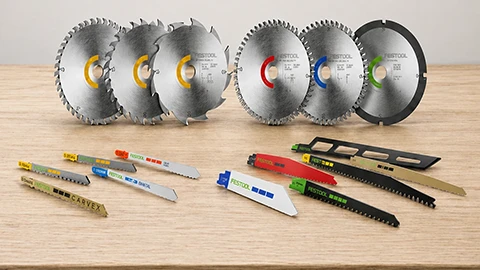
With a high-quality jigsaw, you can work with a wide variety of materials and cut your workpiece with precision and minimal tear-out. The right saw blade makes all the difference: Designed for specific materials and applications, Festool jigsaw blades ensure clean cuts and efficient work. The Festool jigsaw blade range includes blades for wood as well as blades for plastic, metal, and building materials.
WOOD Jigsaw Blade
Wood
WOOD Jigsaw Blade

Jigsaw blade designed for use on wood, delivering clean, tear-free cuts. Available in various styles for fast, right-angle, highly precise, or curved cuts.

Jigsaw Blade for Plastics
Plastics
Jigsaw Blade for Plastics

Jigsaw blade for cutting solid plastic, fiber-reinforced plastics, plastic profiles, acrylic glass (e.g., Plexiglas®), soft plastics, as well as laminate and melamine-faced panels (e.g., Trespa®).

Jigsaw Blade for Metal
Metal
Jigsaw Blade for Metal

The jigsaw blade for tear-free cuts in aluminum, non-ferrous metals, steel, and sandwich materials.

Jigsaw Blade BUILDING MATERIALS
Building materials
Jigsaw Blade BUILDING MATERIALS

The jigsaw blade is designed for gypsum-bonded and cement-bonded particleboard and fiberboard, soft insulation materials, brick and ceramic, cardboard, and polystyrene.

Jigsaw FAQ
Frequently asked questions about application, selection, and use.

Basics and Functions

What is the stroke length of a jigsaw?

The pendulum action on a jigsaw refers to an additional back-and-forth movement of the saw blade that increases cutting speed. Depending on the material and application, different pendulum settings can be selected to achieve faster cuts, better curve tracking, or cleaner cut edges.

“The pendulum action significantly speeds up the cut. For clean visible edges, I turn it down—this reduces tear-out at the cut edge,” explains Festool Product Manager Tobias Beisbarth.

What are the differences between a jigsaw and a pendulum jigsaw?

The main difference between a jigsaw with and without a pendulum action lies in its cutting performance and intended use. A jigsaw with a pendulum action enables fast cutting progress when making straight cuts in wood. A jigsaw without a pendulum action, on the other hand, offers maximum control and ensures particularly precise, clean cuts—for example, when making curved cuts or working with delicate materials.

Pendulum-action jigsaws like the Festool PSB 300 EQ-Plus combine both advantages in a single tool. Thanks to adjustable pendulum action settings, the cutting speed can be flexibly adapted to the material and application—for fast wood cuts as well as for controlled precision work.

Why is automatic speed control needed?

The automatic speed control reduces the speed at the start of the cut and increases it to the maximum speed when under load (fully engaged with the material). This makes it easier to position the tool and begin cutting into the workpiece.

Accessories and saw blades

Why do you need shatter protection?

The splinter guard (also known as a tear-out guard) on the Festool jigsaw reduces tear-outs along the cut edge, especially when working with laminate, veneered, or coated panels. The splinter guard presses the material down on the top side of the workpiece during cutting, ensuring clean cuts with minimal tear-out.

Do I need different saw shoes / soles for different materials?

Different saw shoes or protective pads are useful for protecting delicate surfaces, such as coated panels or metals, from scratches. At the same time, they improve the guidance of the Festool jigsaw on delicate materials.

How often should saw blades be replaced?

Saw blades should be replaced as soon as the cut quality deteriorates, more force is required, or the material starts to burn.

To maximize the jigsaw blade’s service life, always use the appropriate Festool blade for the specific material. Therefore, it is recommended to replace the blade whenever you switch materials. This not only ensures better cut quality but also reduces wear and increases cost-effectiveness. Festool’s clear color coding makes it easy to quickly select the right saw blade.

What should I keep in mind when changing the saw blade?

Before changing the saw blade, the jigsaw must be turned off. To do this, remove the battery or unplug the power cord. The saw blade shank should be inserted correctly and secured firmly so that the jigsaw blade is guided stably during cutting.

When replacing the saw blade, make sure to use the Festool jigsaw blade that is suitable for the material. Festool’s practical color-coding system makes it easy to quickly select the right jigsaw blade for the specific material.

Applications and Materials

How do you make clean, straight cuts with a jigsaw?

Clean, straight cuts with a jigsaw require the right blade, a steady hand, and proper settings. A reduced pendulum action, a consistent feed rate, and a clear view of the cutting line significantly improve precision.

For optimal results when sawing, always use a jigsaw blade that is suitable for the material. Only a blade selected for the specific material ensures precise cuts, high cut quality, and minimal wear. Festool offers the right jigsaw blade for every application. Festool’s color-coding system makes it easy to quickly select the correct jigsaw blade for wood, metal, or other materials.

Can I cut laminate flooring without leaving any tear marks using my jigsaw?

Yes, you can cut laminate without tearing it using a jigsaw. To do this, use a special laminate saw blade (such as the Festool PLASTICS LAMINATE jigsaw blade), a splinter guard, and a reduced pendulum stroke. For particularly clean cut edges, you can also saw the laminate from the back to minimize tear-outs on the visible side.

How can you reduce dust and noise when sawing indoors?

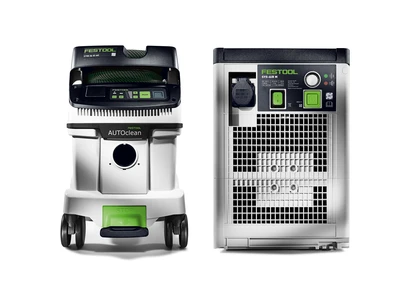
Connecting a dust extraction system significantly reduces dust exposure. That’s why our Festool jigsaws always come with the appropriate extraction adapters included. When used with the right Festool mobile dust extractors, you can drastically reduce dust exposure both on the job site and during stationary use. Dust and sawdust are reliably extracted directly at the cut. This keeps the view of the cutting line clear at all times and facilitates precise work. 

In addition, sharp saw blades and optimized stroke rates reduce vibrations and noise levels.

Possible Problems and Solutions

My jigsaw cuts crookedly. What can I do?

“If a jigsaw cuts crookedly, in practice it’s almost always due to the saw blade or the settings,” says Nadja Körbel, Festool application expert. 

If a jigsaw cuts crookedly, the cause is often unsuitable or dull saw blades, an excessive pendulum stroke, or incorrect feed rate. Straight cuts are achieved with a jigsaw blade suitable for the material, correct settings, and steady guidance.

Why isn't the jigsaw cutting straight, even though the base plate/table is set correctly?

Even if the saw table is set correctly, dull saw blades, incorrect pendulum stroke settings, or excessive feed rate can result in crooked cuts. Our recommendation from the application engineering team: Always check the saw blades and settings before cutting and adjust them to suit the material.

My saw blade is bending or veering off course—what's causing this?

If a jigsaw blade bends or veers off the cutting line, it is usually because the blade is unsuitable, too long, or dull. An excessively high feed rate or incorrect settings can also cause the blade to veer off to the side.

What could be the cause if the material burns, smolders, or melts?

Material burns are usually caused by excessive stroke rates or dull saw blades. Reducing the speed and using a sharp, appropriate saw blade prevents overheating.

What should you do if the jigsaw jams or vibrates heavily while cutting?

Jamming or excessive vibration is often caused by using the wrong saw blade or material tension. A properly matched jigsaw blade and a steady feed rate ensure smooth operation.